
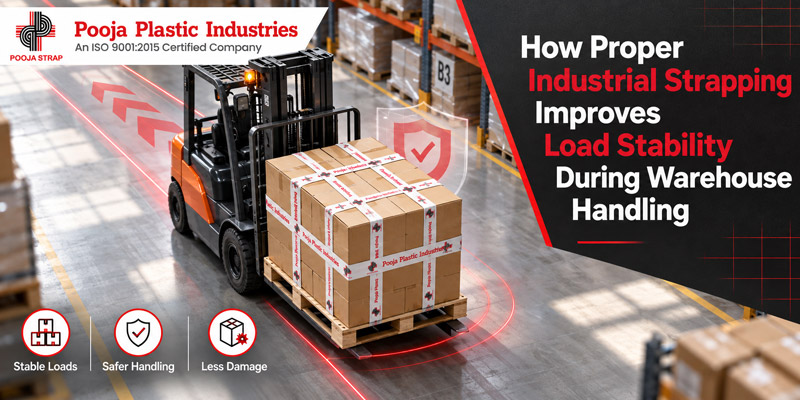
A pallet that seems secure when loaded by the forklift and then reaches the end of the warehouse with half of its top layer rearranged is not merely a minor problem. This is a near miss. According to the kind of products that have shifted, the location and destination of the pallet, this is either a safety issue or a productivity problem. Someone will have to stop, rearrange, re-secure and assess whether any product has been damaged in the process.
Unfortunately, this kind of situation occurs way more often than it is supposed to, and in most cases, this is due to one and the same reason. The load has not been properly secured prior to transport.
Strapping is an intervention between loose stacking and proper securing. In case everything is done properly, including the type of strapping material and its adequate tension, this load will behave in a predictable way at each stage of handling – from its initial stacking to delivery. In case everything is done incorrectly, with improper strap specification or inadequate tension, it will create a false sense of security.
What Strapping Is Actually Doing
The physics are straightforward. Individual cartons or packages stacked on a pallet are connected by nothing except gravity and friction. Gravity keeps them down but does not prevent lateral movement. Friction between packaging surfaces helps but degrades as loads shift and as packaging materials compress under weight.
Strapping adds a physical constraint that prevents the lateral movement that causes instability. Vertical straps hold layers together. Horizontal straps around the load perimeter prevent individual units from separating. The combination creates a bundle that moves as one rather than a collection of units that happen to be in proximity.
The key variables are strap tension and strap positioning. A strap applied at insufficient tension provides minimal constraint because it allows movement before it resists. A strap positioned incorrectly creates a lever point rather than a constraint. Consistent, correct application is what makes strapping effective rather than cosmetic.
Choosing the Right Strapping Material
PP strapping, polypropylene, is the most widely used option in general industrial and commercial warehouse applications. It is relatively lightweight, cost-effective, handles well in manual and automated application, and provides adequate tensile strength for most standard load weights. For lighter carton bundles, consumer goods, and standard pallet loads within normal weight ranges, PP strapping handles the job.
For heavier industrial loads, steel components, machinery parts, dense raw material bundles, the requirements are different. Higher tensile strength, resistance to cutting from sharp edges, performance under higher application tension. PET strapping or steel strapping enter the specification depending on what the load characteristics demand.
The strap width and thickness also affect performance. A narrow, thin strap applied to a heavy load concentrates force over a small contact area, which can damage packaging surfaces and provides less resistance to load movement than a wider strap of appropriate gauge. Matching the strap specification to the actual load weight and dimensions is not a detail to leave to whatever happens to be in the dispenser.
Manual Versus Automated Application
For lower-volume operations, warehouses handling varied load configurations, or packaging lines where product dimensions change frequently, manual strapping with a handheld tool is the practical approach. It is flexible, requires minimal capital investment, and handles irregular loads that automated systems would struggle with.
The limitation of manual strapping is consistency. Applied tension varies between operators, between the start of a shift and the end of one, and between an experienced operator and a new one. This variability is acceptable in low-volume settings where loads can be inspected individually. In high-volume operations, it becomes a systematic source of inconsistency.
An automatic strapping system for packaging lines addresses this by applying the same tension, the same strap position, and the same cycle time to every load regardless of which shift is running. The first pallet of the day and the last are strapped identically. For operations where throughput matters and where consistent load security is a quality requirement rather than an aspiration, automation is a genuine operational improvement rather than a capital expenditure looking for justification.
Integration with the broader packaging line, conveyors, wrapping stations, labelling, is what makes automated strapping work as part of a system rather than as an isolated machine. The strapping station should not be the constraint that determines line speed.
Maintenance and Operator Training
Equipment that is not maintained does not perform consistently. An automatic strapping machine running with worn strap guides, incorrect tension calibration, or degraded sealing components is not providing the performance that justified the investment. Regular maintenance schedules, correct tension calibration checks, and component replacement before failure rather than after are what keep automated strapping delivering consistent results.
Operator training matters even for automated systems. Understanding how to handle different strap configurations, when to adjust settings for different load dimensions, how to identify when the machine is not performing correctly, and what to do when it does not. These are not advanced technical skills but they do need to be explicitly trained rather than assumed.
Strapping as Part of Warehouse Process Design
The most effective approach to load security is treating strapping as a designed element of the warehouse handling process rather than a finishing step that gets attention when loads are obviously unstable. Where in the workflow does strapping happen? Who is responsible for correct application? What are the specifications for different load types? How is consistency verified?
Answering these questions explicitly produces better outcomes than leaving strapping application to individual judgement and discovering variability when product arrives damaged or loads fail during handling.